We often answer that question in visual terms. A recurring palette. A familiar subject. A brushstroke that can be identified across a room. Over time, these become an artist's signature, allowing their work to be recognized almost instantly.
Rabee Kiwan proposes another way of thinking.
Across painting, photography, video, found imagery, and ceramics, his work rarely settles into the same visual language for long. The shift from one body of work to the next can feel almost abrupt. Yet the longer one spends with his practice, the clearer it becomes that consistency was never meant to be found in the medium itself. It lies elsewhere—in the conviction to pursue an idea until it discovers the form it requires.
Growing up between Damascus and his family's village in Sweida, Kiwan inhabited two very different worlds. Damascus was dense, restless, and constantly in motion; Sweida offered a slower rhythm and a different relationship to landscape and community. Looking back, he laughs, describing it as "a strange mixture." Yet moving between those contrasting environments taught him to pay attention—to notice how people, places, and ways of living shift depending on where you stand.
Drawing, however, never shifted.
Although he is the only professionally trained artist in his family, creativity was always close at hand. He remembers watching his late older brother draw with extraordinary precision long before either of them imagined art as a profession. Those early memories confirmed something Kiwan already sensed himself. From as early as he can remember, drawing felt less like a decision than a certainty. There was never another life he imagined for himself.
That certainty eventually led him to the Faculty of Fine Arts in Damascus and into a career sustained entirely through artistic practice. Along the way, it also led him to question one of the assumptions artists most often speak about: that experience always makes the work better.
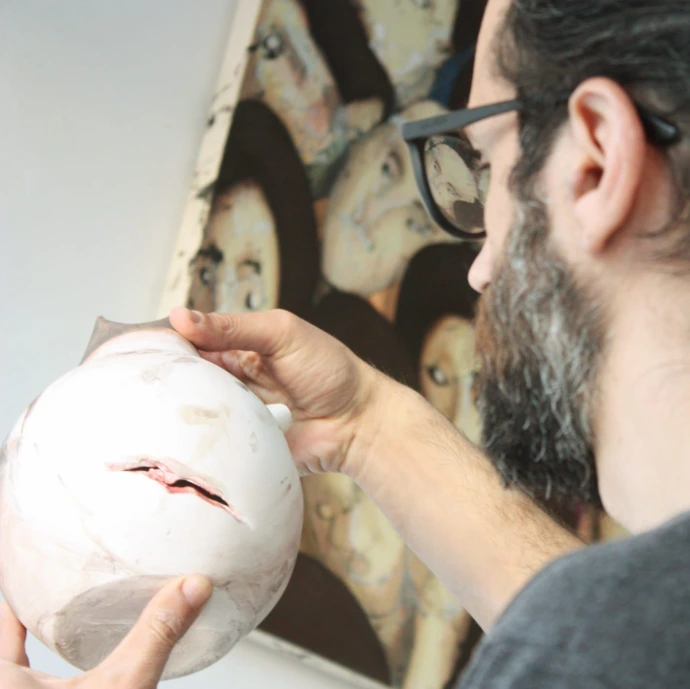
Experience certainly sharpens the eye. It expands knowledge, introduces new references and deepens technical ability. Yet it also changes the relationship between the artist and the work. The more one knows, the harder it becomes to approach a blank canvas without judgment.
Looking back at paintings he made more than a decade ago, Kiwan sometimes finds himself drawn to their directness. They belong to a period before accumulated knowledge began to interrupt instinct. Artistic growth, he suggests, is therefore not only a process of adding, but of learning what to set aside. Technique matters. So does preserving enough openness to allow discovery to remain possible.
That way of thinking has shaped the course of his career.
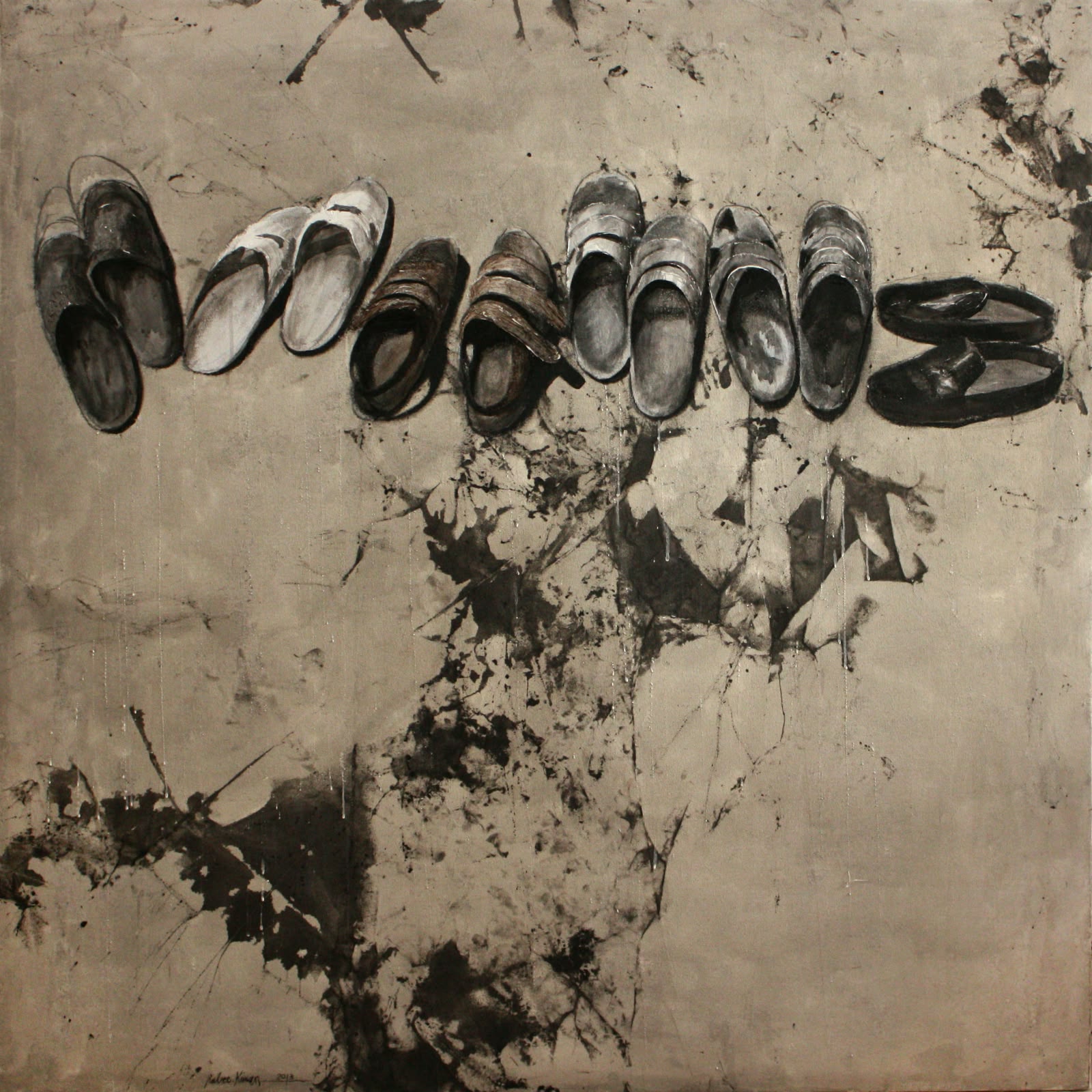
Like many artists, Kiwan spent years navigating the demands of exhibitions, galleries and sustaining a practice financially. Returning to Sweida marked a turning point. It gave him something increasingly rare: time. The slower pace allowed ideas to mature over months and sometimes years, making reading, research and even abandoning projects part of the creative process. Rather than producing work continuously, he found himself waiting until an idea felt fully formed.
Some of the most revealing moments in our conversation centered not on completed works, but on unfinished ones.
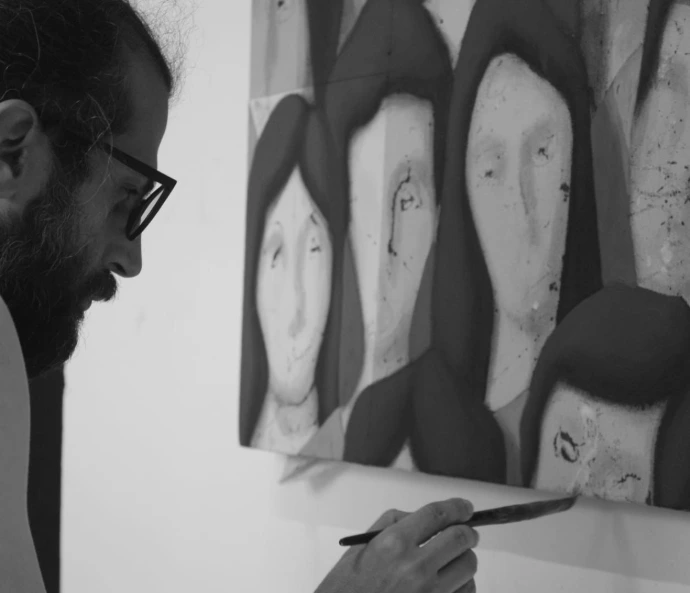
One long-term investigation drew him to the visual traditions of ancient Mesopotamia and the Levant. Immersing himself in Sumerian and Assyrian sculpture, he explored how those forms might enter a contemporary practice without becoming historical quotation. Several paintings found their way into private collections, yet Kiwan never considered the project complete. He later asked collectors not to exhibit those works, intending to return to them only when the questions behind them had evolved further.
It is a striking gesture in an art world that often values production above process. For Kiwan, conviction arrives before completion. A work enters the world only when he believes it has reached its clearest expression.
The medium follows the idea, not the other way around.
That same approach runs throughout his practice. Each body of work begins with a different point of departure: a historical image, an observation, a bureaucratic document, or a personal encounter. The medium follows the idea, not the other way around.
His series exploring passport photographs, for example, begins with one of the most ordinary images we produce. Stripped of context and reduced to administrative function, the passport photograph becomes a symbol of how institutions attempt to define identity. Kiwan pushes beyond that fixed image, asking what remains unseen—what exceeds the frame, the document and the system designed to classify us. In another body of work, the same curiosity takes shape through pixels, expressive painting or ceramic forms. Each project arrives at a different visual language because each begins by asking a different question.
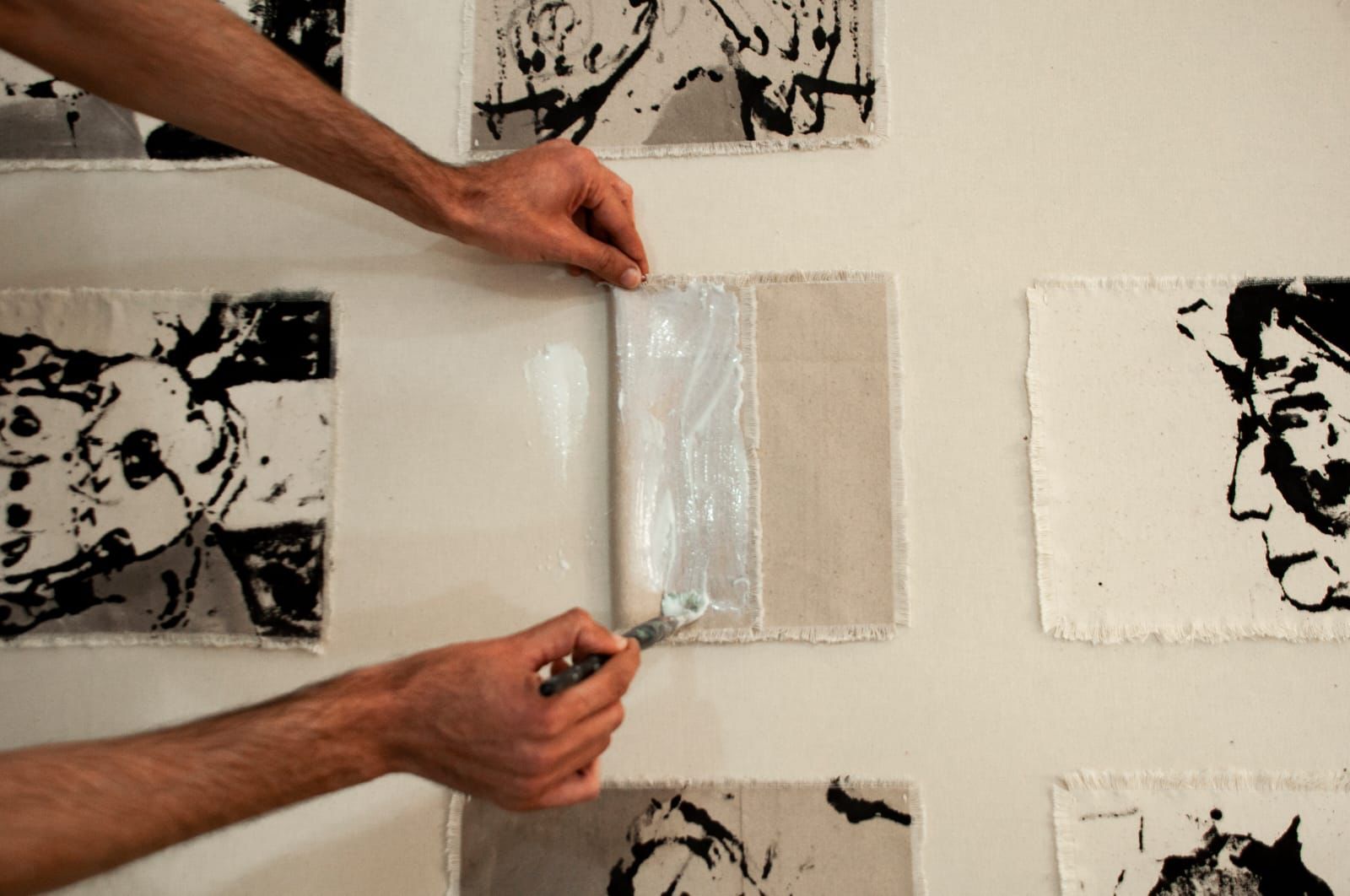
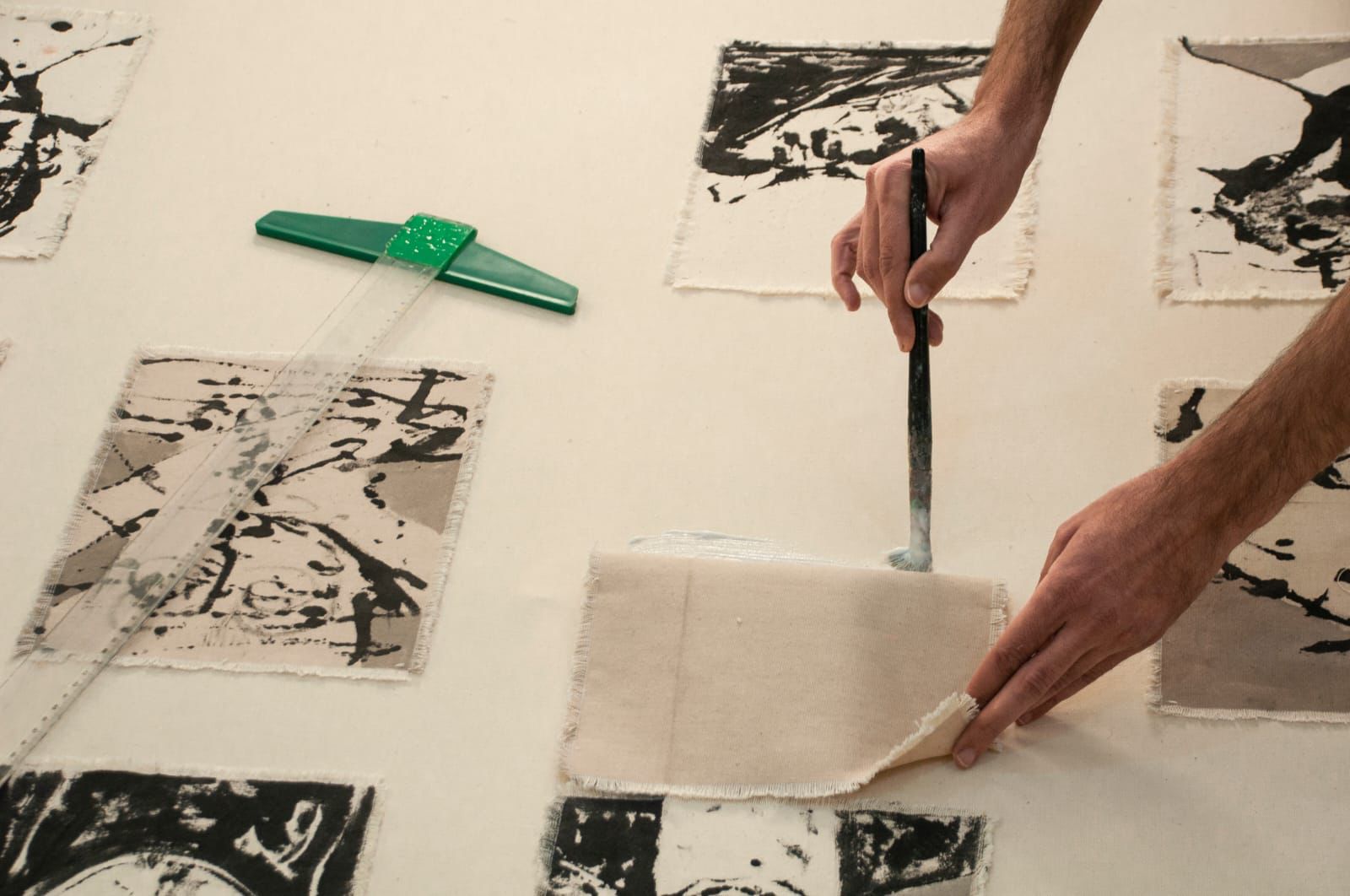
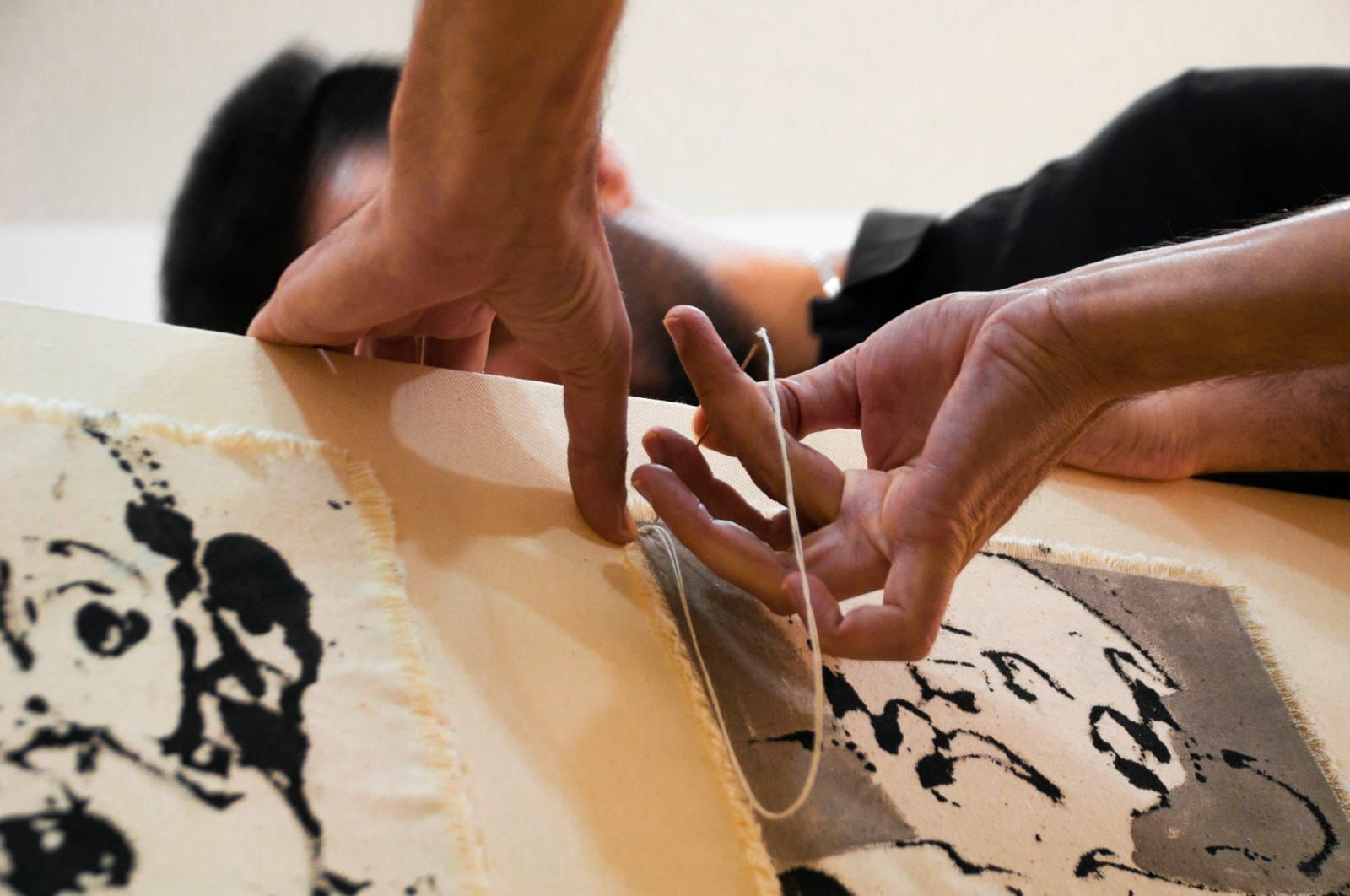
Canvas fragments glued and stitched into place, in the studio.
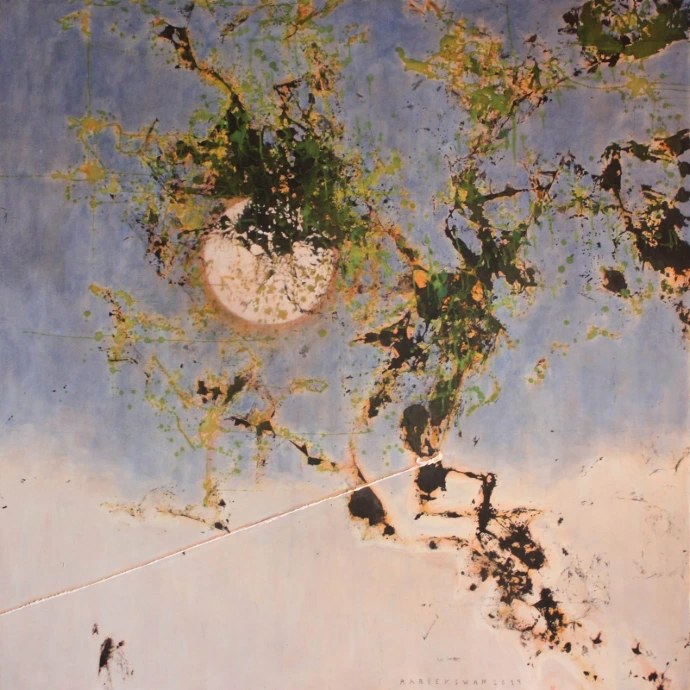
This commitment to following the work rather than repeating it finds one of its clearest expressions in Black. The series did not emerge as a dramatic departure so much as the culmination of years spent experimenting, discarding and refining. Thick black contours, layered surfaces and enlarged eyes create paintings that feel simultaneously contemporary and ancient, carrying echoes of the visual traditions that occupied his earlier research. Rather than quoting history, Kiwan absorbs it into his own vocabulary, allowing those references to reappear transformed through painting.
What is striking is not simply how different Black looks from his earlier work, but how naturally it grows from the questions that preceded it. Each body of work leaves traces in the next, not through repeated imagery, but through an evolving way of seeing.
Perhaps the clearest insight into Kiwan's practice came through an unexpectedly simple admission. Reflecting on his work, he estimated that only around five percent of what he makes truly satisfies him.
The remark says less about perfectionism than it does about an artist whose standards continue to evolve. As his eye changes, so does his understanding of what a finished work can be. Completion is never simply the moment a painting leaves the studio. It is the point at which an idea has reached the clarity it demands. Until then, a project may remain in the studio for years, return in another form, or disappear altogether.
That patience is increasingly rare. Contemporary artistic practice often rewards visibility, consistency and constant production. Kiwan has chosen a slower path—one that allows ideas to develop at their own pace and accepts uncertainty as an essential part of the process. It is a practice built less on certainty than on attention: the willingness to look closely, to question first impressions and to remain open to where an investigation might lead.
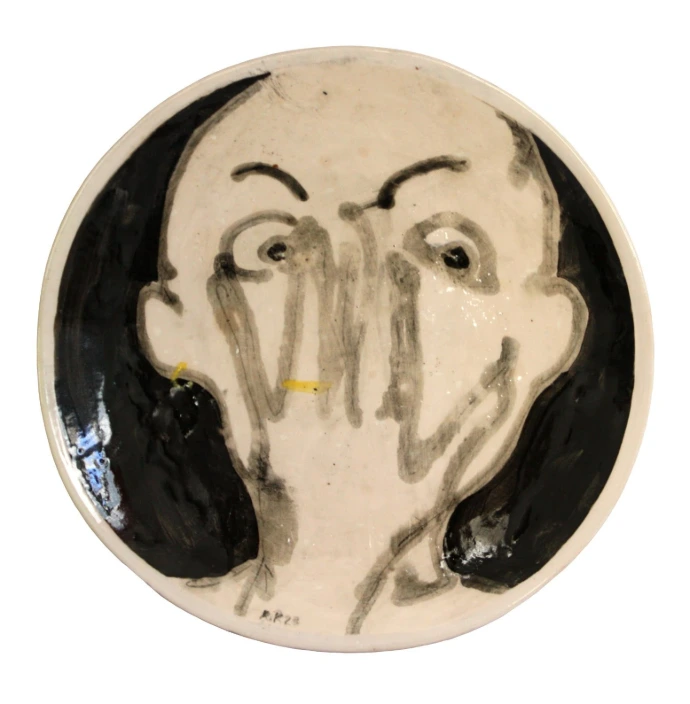
Returning to the question of what makes an artist recognizable, Kiwan offers an answer that extends beyond style. Across painting, photography, video, found imagery and ceramics, each project begins with a different inquiry and discovers its own visual language. His work evolves because his questions evolve. Rather than returning to the same image, he returns to the same commitment: following an idea until it reveals the form it was always meant to take.
His paintings do not resemble one another as much as they resemble the mind that made them.