To create is to tell the truth. Whether it lands on a canvas as a political wound or a private memory, the act of making art is among the most personal things a human being can do. But from that moment of creation to building a life from it — that journey is rarely in the artist's hands.
How do artists sustain themselves? How do they find the eye that truly sees what they’ve made? How do they make sure the story behind the work doesn't get swallowed by the transaction of selling it? These are questions that artists — particularly those working from corners of the world that the global art market has long overlooked — have been asking for a long time without a satisfying answer.
SUR, a new artist management platform, is trying to answer that distance. Founded by Nour Saeed and Sulafa Al Shami, it operates less like a gallery and more like a dedicated advocate—one that sits with artists, learns their work, and finds ways to connect them with collectors in a meaningful, sustained way.
Their first public expression of this was a private viewing at a private residence in Amman, one of the eight artists SUR is currently working with. Between 80 and 100 guests attended — collectors and art lovers, friends and family. What they found was a curated selection of works by Abd Kasha, Dzovig Arnelian, Hussam Hasan, Johnny Semaan, Maher Rawi, Rabee Kiwan, Tayf Al-Masri, and Hammoudeh — artists from Syria, Lebanon, Palestine, Jordan, and Iraq, brought together under loose but legible themes of identity, belonging, and gender roles.
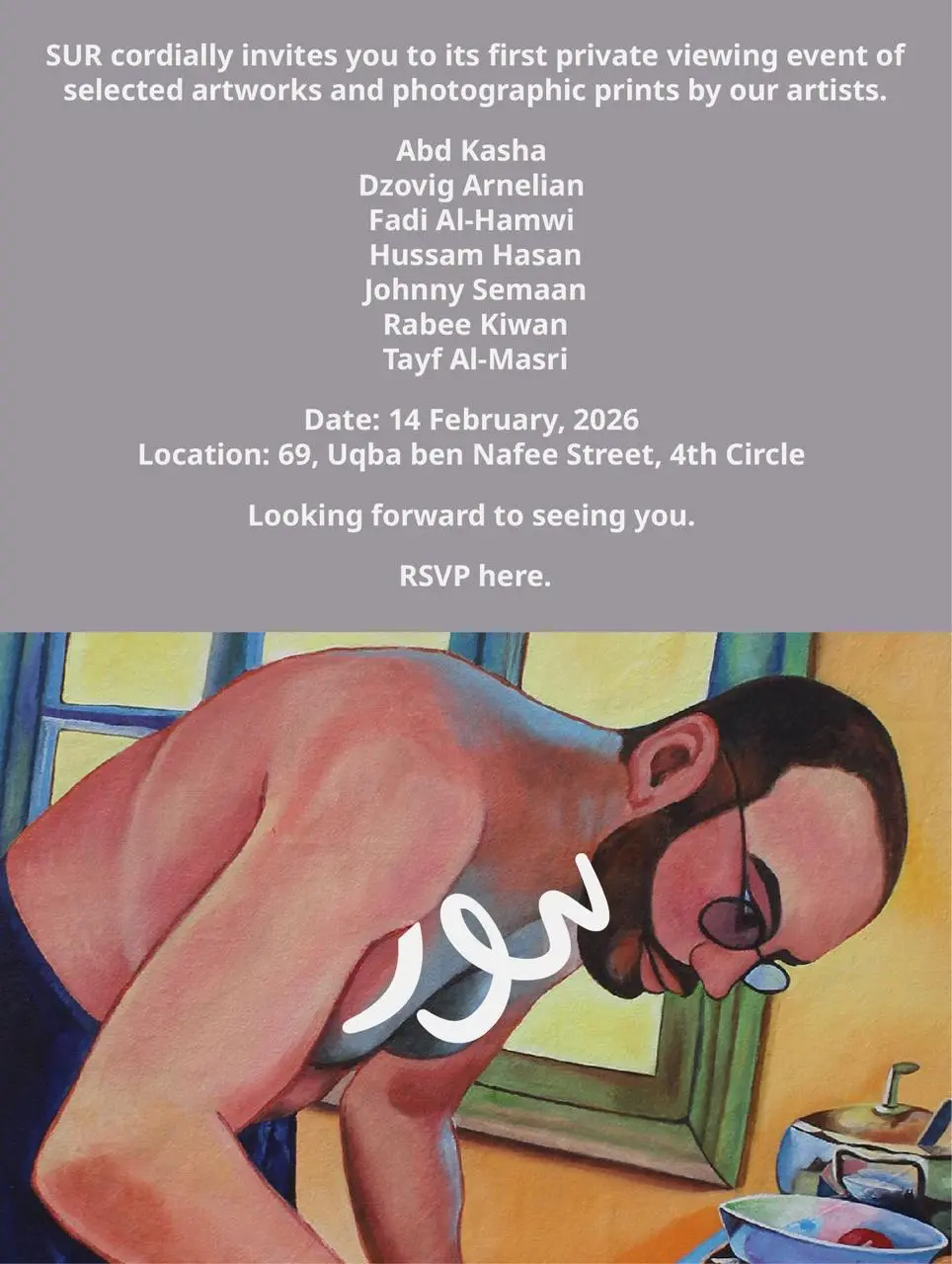
Some of the works carried their own history into the room. Rabee Kiwan showed pieces from different stages of his career, drawn from collections including Pixels, Passport Photos, and Rhythm B. Tayf Al-Masri's wall sculptures came from his debut solo exhibition, Habitus. Dzovig Arnelian's watercolor and acrylic paintings were from her solo show Yawmiyat Rajol — Diaries of a Man. Several of the artists were not present, many unable to travel because of paperwork they don't have.
The experience SUR designed that evening was deliberate in its atmosphere. Unlike the often transactional feel of a traditional gallery, the space invited people to engage with the work on its own terms — to absorb it, ask about it, and understand it without the pressure to buy. For first-time collectors in Amman, the event also offered something practical: access to mid-career artists at price points that are approachable without being marginal.
Nour and Sulafa arrived dressed by artist Salim Azzam. The placement of each piece, the flow of the space — all of it was considered. "We wanted a full-on artistic experience," said Nour. The curation did its job: attendees could feel a common thread running through the pieces, a harmony across four countries and eight different practices.
"We care about introducing the artist in an intentional and structured way, positioned in a thoughtful way that gives them the weight they deserve," said Sulafa.
There is a reason SUR chose Amman as the starting point. "Amman felt like the right place to launch because of the cultural intimacy and the strong artistic roots," said Nour. "We grew up in Amman, and we wanted to start where we started."
The city is easy to underestimate. Its skyline is not dramatic. Its art scene does not make international headlines the way Beirut does, or Dubai increasingly does. But spend time in it and you start to understand what it actually is: a city that has absorbed wave after wave of Arabs seeking refuge and reinvention — Syrians, Palestinians, Lebanese, Iraqis. Limestone buildings stacked on hills, a kind of lego land that keeps building itself upward. A true melting pot, in the most literal sense of the word.
That history has produced something. A collector base that is informed, sophisticated, and genuinely invested in art as cultural currency. A network of artists and patrons who have been quietly building something for years. And an intimacy — a smallness, even — that makes it possible to build relationships between artists and the community.
But the ambition is bigger than the city. SUR wants to elevate Amman's art scene, yes — to make art a social experience, something you do on a Tuesday evening the way you might go to dinner or a film. An art date. A perfect day. And from there, to take it further. Pop-up exhibitions on a quarterly basis, in different cities and different countries. A website. An online store. Written profiles of artists. An educational platform about the region's art history and art today.
"We want to create opportunities for artists to generate income while focusing on their art, their practice, or preparing for exhibitions and residencies," said Nour. "SUR is trying to break away from the traditional, transactional, often impersonal way of presenting and selling art."
What SUR is building, at its core, is a different kind of relationship between artist and platform. Between artwork and collector. Between a region's stories and the world that has not yet fully heard them. It’s providing space to introduce artists that are not your usual suspects, and the opportunity for people to invest in them.